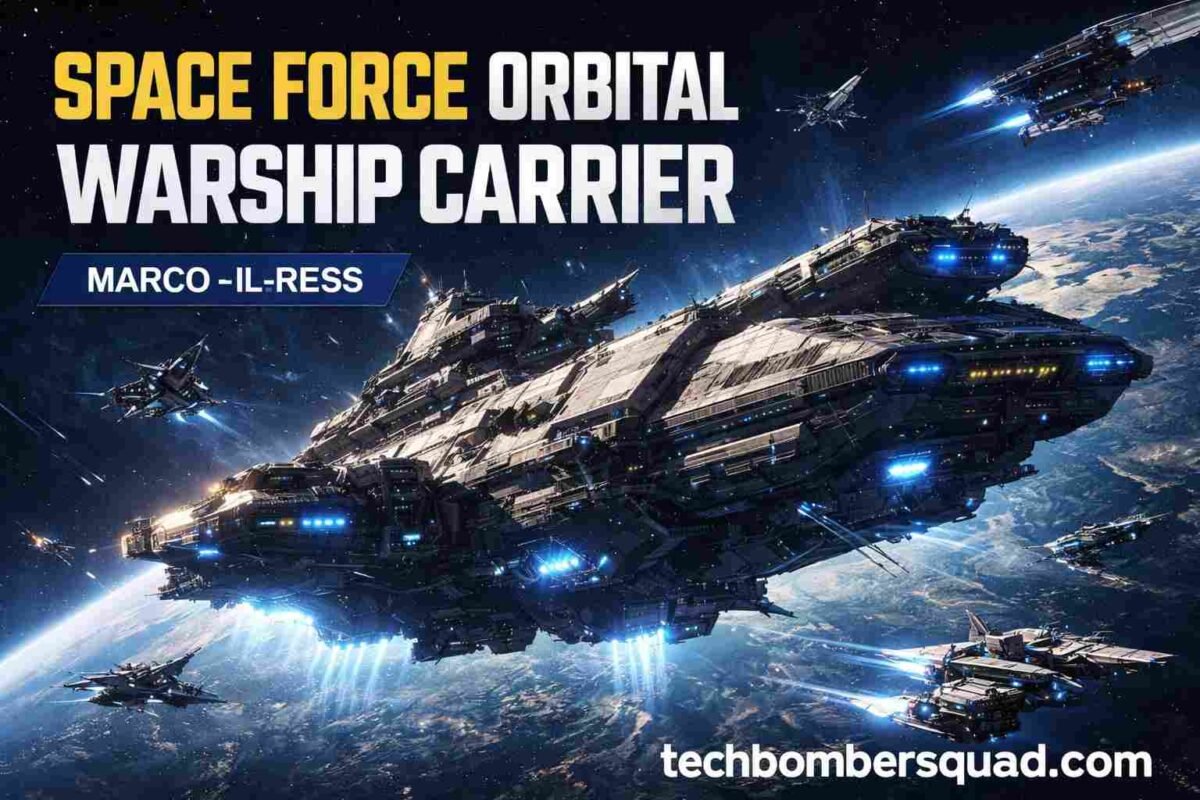
As space becomes more of a domain for technological and military advancements, the idea of a Space Force Orbital Warship Carrier has emerged as a concept with great potential for the future of warfare. This idea combines the strategies of modern-day naval warfare with the expanding frontier of space exploration. As nations and organizations around the world look to secure their interests in space, the idea of space-based military power is becoming more feasible. But what exactly is a Space Force Orbital Warship Carrier, and how would it work in the ever-expanding universe of defense?
In this blog post, we will dive deep into the concept, features, and potential of space carriers, examining their future role in space warfare. We’ll explore the key features of these ships, the technology they would require, and how they could revolutionize defense strategies on Earth and beyond.
The Concept of Space Force Orbital Warship Carriers
To understand the concept of a Space Force Orbital Warship Carrier, we must first break down what it means. An orbital warship carrier is essentially a large spacecraft designed to serve as a mobile base of operations in space. Much like naval carriers that launch aircraft and provide support in the oceans, these warship carriers would function as a hub for spacefighters, drones, and smaller ships. They would operate in low Earth orbit or beyond and be capable of defending Earth from space-based threats or launching offensive strikes.
The idea of these carriers isn’t purely science fiction. The rise of space militarization and technological advances in space propulsion and weaponry has made the idea more plausible. In the coming decades, Space Force Orbital Warship Carriers could form the backbone of space defense fleets, protecting satellite systems, commercial space stations, and potentially even interplanetary colonies.
Key Features of a Space Force Orbital Warship Carrier
To function effectively, a space carrier would need a set of robust features designed for both defense and offense. These features are crucial for making such a concept feasible in the long term.
Carrier Platform
The core function of a Space Force Orbital Warship Carrier is to act as a mobile platform that supports spacecraft. These ships would need:
- Launch Bays and Docking Ports: These would allow fighter spacecraft, drones, and cargo ships to launch, dock, and be refueled/rearmed.
- Command Center: This would serve as the brain of the operations, where high-tech systems and artificial intelligence would be used to control battles and coordinate operations in space.
- Living Quarters and Artificial Gravity: Long-term missions would require life support systems and areas for the crew to live and work. Artificial gravity would ensure the crew remains functional over extended periods.
Defensive Capabilities
A Space Force Orbital Warship Carrier must be heavily protected from both physical and cyber threats. Some of the defensive systems could include:
- Energy Shields: To protect the carrier from debris, asteroids, and incoming projectiles or laser weapons.
- Point Defense Systems: Small, rapid-fire energy weapons or railguns that could intercept and destroy missiles or smaller ships.
- Stealth Technology: This would allow the carrier to reduce its radar or sensor signature, avoiding detection by enemy forces.
Offensive Capabilities
The main goal of these carriers is to provide offensive capabilities in space combat. This includes:
- Orbital Bombardment Weapons: The carrier could deploy energy-based weapons or kinetic energy projectiles to strike planetary or space-based targets.
- Fighter Craft and Drones: A fleet of spacefighters and drones could be deployed to engage in dogfights or strike targets on the ground.
- Missile Launchers: The carrier could be equipped with long-range missiles capable of striking other spacecraft, military stations, or terrestrial targets.
Technological Innovations Required for Space Force Warship Carriers
For space carriers to become a reality, several technological advancements must be realized. Here are some of the critical innovations that would make them feasible.
Advanced Propulsion Systems
Currently, space propulsion technology is limited to chemical rockets. However, a Space Force Orbital Warship Carrier would require advanced propulsion systems capable of faster-than-light (FTL) travel or at least the ability to travel across vast distances in a reasonable time frame.
This could involve technologies like ion propulsion or nuclear fusion engines that provide continuous thrust over long distances, with minimal fuel consumption. These systems would allow a carrier to travel between Earth, the Moon, or even Mars, depending on the mission.
Laser and Plasma Weapons
Traditional projectile-based weapons are not ideal for space combat due to the vacuum of space. Instead, laser weapons, plasma cannons, and railguns would be more efficient. These weapons would need to be highly accurate and capable of destroying fast-moving targets in space.
Laser weapons, in particular, offer unlimited ammunition (provided there’s enough power) and the ability to strike with incredible precision at vast distances.
Autonomous Systems
Given the vast distances and complexity of space operations, autonomous drones and AI-powered systems will be crucial. These systems would assist in surveillance, repairing the ship, launching and recovering spacecraft, and combat strategies. AI-driven systems would manage multiple aspects of the warship’s functionality, ensuring that crew members can focus on critical decision-making.
Roles and Functions of a Space Force Orbital Warship Carrier
The Space Force Orbital Warship Carrier would serve multiple roles, both strategic and tactical, in the future of space warfare.
Strategic Command
The primary role of a space carrier would be to act as a command center for space operations. It would oversee a fleet of smaller ships and act as a hub for intelligence and reconnaissance. In this role, the carrier would ensure the defense of space colonies and orbital stations, making it an essential part of interplanetary defense.
Interplanetary Defense
As humanity expands its presence across the solar system, the need to defend space stations, colonies on the Moon or Mars, and even commercial satellites becomes more critical. A space carrier could be stationed near these colonies to provide a defensive shield against enemy ships, asteroids, or hostile forces.
Offensive Operations
A space carrier would also serve as a launching point for offensive operations. Whether it’s engaging in space combat or conducting orbital strikes on enemy targets, the carrier’s size and weaponry would allow it to take on major offensive actions. Its large-scale deployment of fighter spacecraft and drones could also provide an immediate advantage in space battles.
Challenges and Considerations
While the concept of space carriers is exciting, there are a few challenges that need to be addressed:
Cost and Resources
Building and maintaining a Space Force Orbital Warship Carrier would come at an astronomical cost. The technological innovations, powerful weapons systems, and logistical support required would be a significant financial investment for any nation. Ongoing funding would be needed for the ship’s operations, repairs, and crew training.
International Space Laws
There are international treaties and agreements that regulate the militarization of space. The Outer Space Treaty of 1967, for instance, bans the placement of nuclear weapons in space and limits military activities to peaceful purposes. These laws would need to be updated to account for the growing importance of space defense and warfare.
Space Logistics
Logistics in space—fueling, repairing, and rearming—pose another challenge. Unlike Earth, where supplies can be transported quickly, space logistics would require a constant supply chain. Refueling stations and repair docks would need to be developed to ensure warships can maintain their operations over long periods.
The Future of Space Force Orbital Warships: Is it Feasible?
As of now, the technology and resources required to build Space Force Orbital Warship Carriers are not fully available. However, the rapid pace of space exploration and military advancements suggests that these carriers could be a reality within the next few decades. Space mining, nuclear fusion, and AI-powered defense systems are just some of the innovations that may push us closer to this goal.
Conclusion
The idea of a Space Force Orbital Warship Carrier represents a significant leap into the future of military strategy. It offers exciting possibilities for space defense, interplanetary security, and offensive space operations. While challenges remain, technological advancements and international cooperation could soon make space carriers a reality, revolutionizing how we approach warfare beyond Earth.
FAQs
What is a Space Force Orbital Warship Carrier?
A Space Force Orbital Warship Carrier is a large spacecraft designed to carry, deploy, and support smaller ships or fighters in space combat and operations.
How would space carriers differ from naval carriers?
Unlike naval carriers, which operate in oceans, space carriers would function in outer space and support fighter crafts, drones, and missiles for both defensive and offensive operations.
What are the defensive capabilities of a space warship carrier?
They would feature energy shields, point defense systems, and stealth technologies to protect against space threats like missiles, debris, and enemy spacecraft.
What role would space carriers play in interplanetary defense?
They would act as a command center for space fleets, defend colonies on planets like Mars, and ensure the safety of satellites and space stations.
Are there any legal issues related to space warships?
Yes, the Outer Space Treaty restricts military activity in space to peaceful purposes. Space militarization laws will need to evolve as the technology becomes more advanced.
About the Author